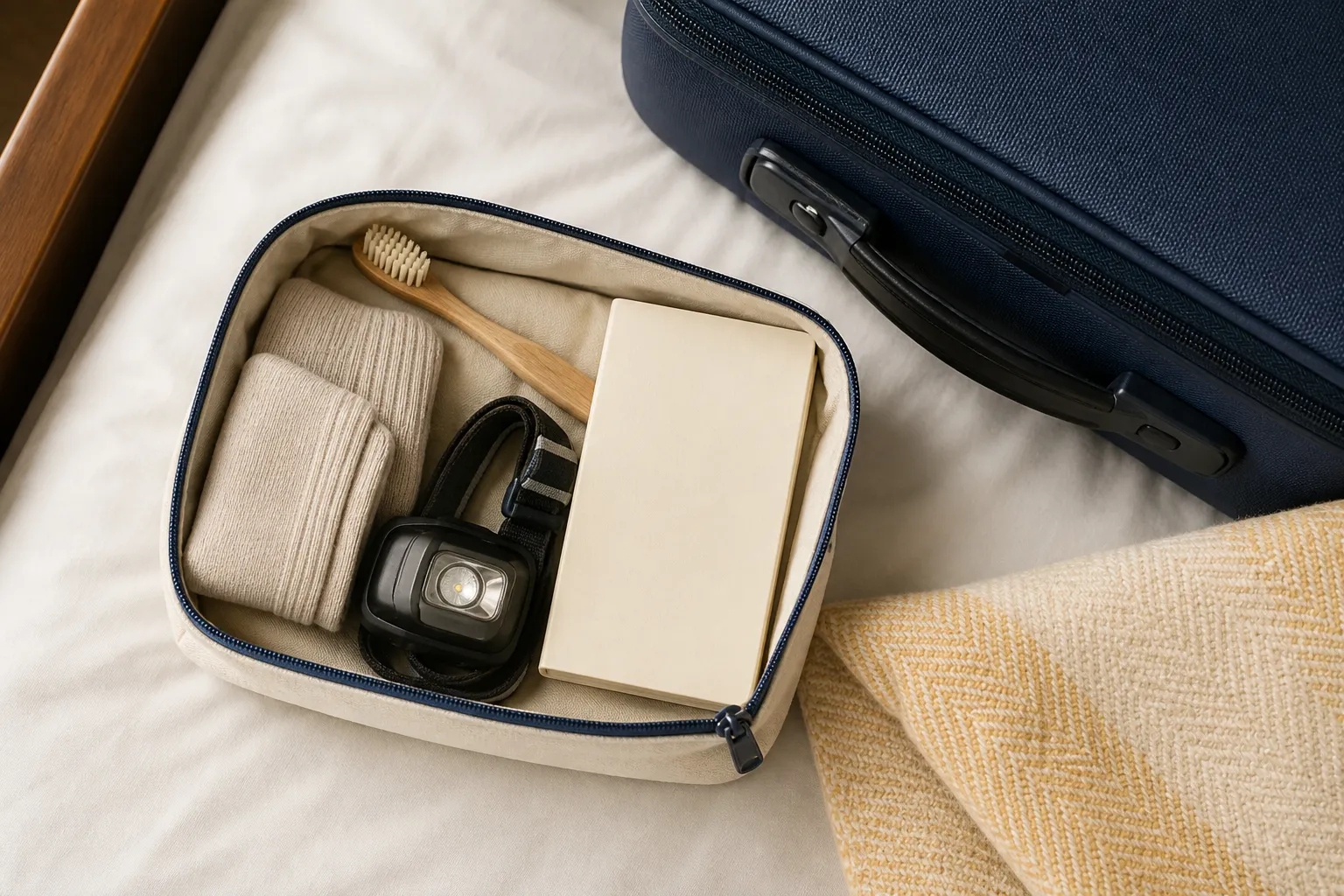
Why a Separate Pouch Works Better Than “One Big Bag”
Overnight travel creates a strange schedule: you need a few items repeatedly in dim light, but the rest of your belongings are irrelevant until morning. If everything is packed in one large case, each small need turns into a search operation. You unzip, move layers, and disturb your berth while others are already trying to sleep.
A night pouch solves that problem by separating “night-use” from “tomorrow-use.” It should be small enough to sit beside your pillow or against the wall shelf, yet large enough to hold hygiene basics, comfort items, and one backup layer. Think in terms of access speed, not total capacity.
Choose the Pouch Before You Choose the Contents
People often start with a long packing list and then cram it into whatever bag they have. Reverse the process. Pick the pouch first, then allow only items that fit neatly without force. This creates a hard limit that protects you from overpacking.
- Soft-sided zip pouch with one internal divider is usually enough
- A flat base helps it stand on a narrow berth shelf
- Quiet zipper pulls reduce noise during nighttime access
- Dark interior lining makes light-colored items easier to spot quickly
Avoid bulky hard cases unless you specifically need impact protection. In a sleeper berth, rigid containers slide, bump, and take up more usable space than soft pouches.
The Core Contents: What Belongs Inside
Your exact list changes by season and route length, but the principle stays stable: every item should answer a likely nighttime need. If an item is unlikely to be used before morning, keep it in the main bag.
- Earplugs and eye mask for unpredictable noise and light
- Toothbrush, travel-size toothpaste, and a small tissue pack
- Phone cable and compact power bank
- Thin socks or a light layer for temperature drops
- Any personal medication needed during overnight hours
- A small bottle of water with a secure cap
The best night pouch is not comprehensive. It is selective. It removes repeated searching and keeps you out of the aisle when everyone else wants stillness.
What Stays in the Main Bag
Keep daytime items where they belong: folded clothing for tomorrow, full toiletry kits, chargers you will not need until check-in, and spare shoes. If these spill into the pouch, you lose speed and increase clutter. The night pouch should close easily with a single motion.
- Extra clothing beyond one thin comfort layer
- Books, notebooks, and non-essential electronics
- Full-size containers and duplicate hygiene products
- Anything fragile that requires deliberate handling
Pack by Sequence, Not Category
Most people pack by item type: toiletries together, electronics together, accessories together. For a sleeper car, sequence is more useful. Place first-use items nearest the zipper opening and occasional-use items deeper inside.
- Top layer: earplugs, eye mask, tissues
- Middle layer: toothbrush set and medication
- Lower layer: backup socks and power bank
This order lets you retrieve what you need in low light without spreading contents on bedding. If you can find your earplugs in one touch, your setup is working.
Test the Pouch Before Departure
A short home test prevents most onboard mistakes. In a dim room, try opening the pouch and finding five key items in under a minute. If you need to look at each object one by one, reorganize. Night rail conditions are darker and noisier than home, so your test should feel easy, not barely possible.
Quick Pre-Boarding Check
- Pouch closes without strain and keeps shape when lifted
- No metal pieces rattle loudly when moved
- Liquids are sealed and isolated from paper items
- Most-used items are reachable near the opening
- You can return everything to place in less than a minute
How This Improves the Whole Car Experience
A tidy pouch does more than help you. It lowers disturbance for everyone sharing the compartment. Fewer zipper runs, less rustling, fewer nighttime trips to the rack, fewer requests to move while someone searches for a charger. The result is not luxury, but a calmer baseline.
That is the real measure of good overnight packing: you stay functional through the night and do not create extra noise around you. If your main suitcase remains closed until morning and your essentials stayed within reach all night, the pouch did its job.